Every week I talk to business owners who are spending ₹50,000 to ₹2 lakh per month on Google Ads — and getting decent results — but have never seriously invested in organic search. When I ask why, the answer is almost always the same: "We don't understand how to rank on Google without paid ads. At least with Ads, we know we'll get traffic."
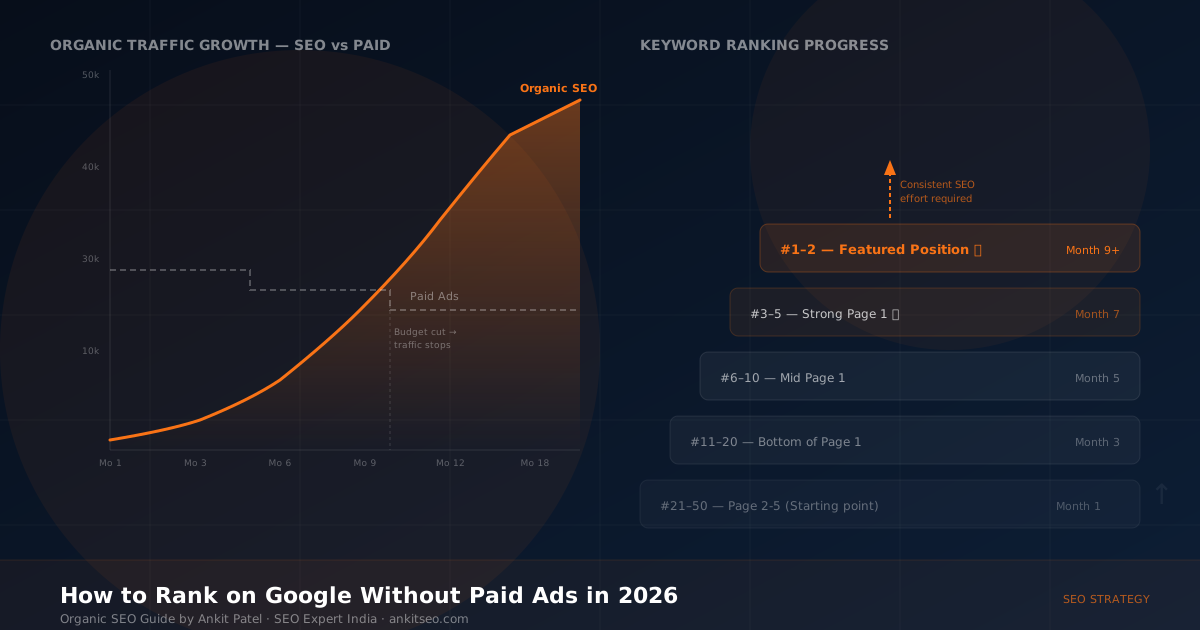
That logic is understandable. Paid ads are immediate, predictable, and controllable. But they're also a perpetual expense — you're essentially renting visibility rather than owning it. The moment the budget stops, so does every click, lead, and sale that came from those ads.
Organic search through SEO is different. It takes longer to build, requires more upfront work, and demands patience. But once your pages rank on Google's first page, they generate traffic 24 hours a day, seven days a week, without paying for every click. The businesses I've worked with that have invested seriously in SEO over 12–24 months have systematically reduced their dependency on paid advertising — and grown more profitable as a result.
This guide is the complete playbook I use with clients: an 8-step framework for earning first-page Google rankings through organic SEO, with no ad spend required. Whether you're a local business in Ahmedabad, an e-commerce brand in Mumbai, a startup in Bengaluru, or a blogger anywhere in India — the same principles apply.
How Google rankings actually work in 2026 · Keyword research and intent analysis · Content creation and on-page optimization · Technical SEO fundamentals · Backlink building without shortcuts · Local SEO for location-based businesses · Topical authority building · A 12-month roadmap · Free tools to use · A full checklist
Can You Really Rank on Google Without Paid Ads?
This question comes up so often because of a misconception: that Google rewards advertisers with better organic rankings. It doesn't. Google's search rankings and its advertising business are entirely separate systems. A company spending ₹10 crore per year on Google Ads gets zero preferential treatment in organic search compared to a company spending nothing.
Organic search rankings are determined by relevance, quality, and authority — not budget. Some of the most-visited websites in India spend essentially nothing on Google Ads because they've invested in SEO over years and now receive millions of organic visitors per month for free.
The websites ranking on page one for your target keywords right now — your competitors — got there through some combination of age, quality content, technical optimization, and backlinks. None of that required ad spend. All of it is replicable with the right strategy and consistent effort.
Organic search is the highest-intent traffic source available. When someone types "SEO agency in Ahmedabad" into Google, they're not passively browsing — they're actively looking to hire someone. Ranking organically for that search captures a user at the exact moment they're ready to engage. Paid ads can achieve this too, but SEO sustains it without ongoing cost per click.
How Google Rankings Work in 2026
Before you can build rankings, you need to understand how Google decides what to show and in what order. The process has three stages, with a fourth layer that has become increasingly important in recent years.
Stage 1: Crawling
Google runs automated bots (crawlers) that continuously traverse the web, following links from page to page. When they land on your site, they read your HTML, follow internal and external links, and note every piece of content they find. If your pages can't be crawled — because of incorrect robots.txt rules, broken links, or JavaScript rendering issues — they won't rank, period.
Stage 2: Indexing
After crawling, Google decides whether to add each page to its search index. Pages with thin content, duplicate content, or technical issues may be crawled but not indexed. Check your Google Search Console Coverage report regularly — unindexed pages are completely invisible in search results.
Stage 3: Ranking
Indexed pages are then evaluated against 200+ signals to determine where they should appear for different queries. The algorithm continuously compares every indexed page against every other for any given search — and the most relevant, authoritative, and user-friendly result wins.
Stage 4: Search Intent Matching (The Critical Layer)
This is where 2026 differs most from five years ago. Google's AI systems now understand the meaning behind queries, not just their words. Ranking for "best accounting software for CA firms in India" requires understanding that the searcher wants a comparison — not a definition, not a how-to guide, not a product landing page. Matching what your content delivers to what the searcher actually expects is as important as any technical optimization.
E-E-A-T: The Quality Layer
Especially for high-stakes topics — health, finance, legal, major purchases — Google evaluates who created the content, whether they have genuine credentials, whether the site is trustworthy, and whether the information is accurate. Building E-E-A-T (Experience, Expertise, Authoritativeness, Trustworthiness) into your site and content is the long-term differentiator that separates durable rankings from fragile ones.
Find the Right Keywords
Keyword research isn't about finding the highest search volume terms and writing pages about them. That approach worked in 2012. Today, it's how businesses end up with dozens of pages that never rank because they're targeting terms dominated by national brands with ten years of authority.
Effective keyword research in 2026 is about finding the intersection of searcher intent, commercial value, and realistic competitive opportunity.
Start With Seed Keywords
Seed keywords are the broad terms that describe your business. If you're a digital marketing agency in Pune, your seeds might be: "digital marketing Pune," "SEO agency Pune," "social media marketing Pune." These seeds become the starting point for discovering more specific opportunities.
Target Long-Tail Keywords First
Long-tail keywords are more specific, lower-competition phrases that indicate higher intent. Compare:
- "SEO" — 1M+ monthly searches, dominated by Wikipedia and HubSpot. Impossible to rank.
- "SEO services for Shopify stores India" — 400 monthly searches, far less competition, extremely high commercial intent. Very achievable.
New and small websites should target long-tail keywords almost exclusively in their first 12 months. Build authority through easier rankings first, then pursue broader terms as domain authority grows.
Understand the Four Types of Search Intent
- Informational: "how to do keyword research" → create a blog post or guide
- Navigational: "Ahrefs login" → they're looking for a specific site
- Commercial: "best SEO tools India" → create a comparison article
- Transactional: "hire SEO consultant Ahmedabad" → create a service landing page with clear CTAs
Before creating any page, Google the keyword yourself and study what type of content appears on page one. That's Google showing you exactly what it believes satisfies this query's intent. Your content must match that format.
Free Keyword Research Tools
- Google Search Console: Shows what queries your site already ranks for — find "page two" keywords (positions 11–20) and optimize those pages for quick wins
- Google Keyword Planner: Free with a Google Ads account, shows search volumes and competition levels
- Google's "People Also Ask" and "Related Searches": Reveals related queries and content gaps to address
- Ahrefs Webmaster Tools (free tier): Shows backlink profile and organic keyword rankings for your own domain
Create High-Quality Content
Content is still the foundation of organic rankings. But "high quality" has a very specific meaning in 2026 that goes well beyond "long" or "keyword-optimized."
Google's Helpful Content system is specifically designed to identify and demote content that exists primarily to rank rather than to genuinely help users. It looks at your site holistically — if a significant portion of your content is created for search engines rather than people, the entire site can be depressed in rankings.
What Makes Content Rank in 2026
- It fully satisfies the search intent. The user who lands on your page should leave with their question answered — not half-answered with a CTA to "contact us for more details."
- It demonstrates genuine expertise. Specific examples, original insights, real data, and nuanced perspectives that only someone with direct experience could provide. Generic facts rephrased from other sources don't cut it.
- It's current. A 2019 article about "SEO strategies for 2019" has no business competing in 2026. Update content regularly — especially anything time-sensitive or in fast-moving industries.
- It's structured for readability. Short paragraphs, clear subheadings, bullet points, and tables. Most users scan before they read. If your page looks like a wall of text, they'll leave.
- It shows authorship clearly. Who wrote this? What are their credentials? An author bio with a real name and verifiable experience dramatically strengthens E-E-A-T signals.
Content Formats That Consistently Rank Well
- Comprehensive how-to guides — like this article — that cover a topic end-to-end
- Comparison articles — "X vs Y," "Best X for Y use case" — high commercial intent, highly linkable
- Data-driven studies — original research is the single most powerful link-building asset
- Service and location pages — for local and transactional keywords, dedicated service pages with specific content outperform generic "we do everything" pages
- FAQ pages — directly targets People Also Ask results and voice search queries
Optimize Your On-Page SEO
On-page SEO is the process of ensuring every technical signal on your page tells Google what it's about. Even excellent content can underperform if these signals are wrong or missing.
Title Tag
The single most important on-page signal. Your primary keyword should be in the title tag, ideally near the beginning. Keep it under 60 characters and make it genuinely compelling — your title is your ad copy in search results. A poor title tag means poor click-through rates, which signals to Google that searchers don't find your result relevant.
Meta Description
Not a direct ranking factor, but a critical influence on click-through rate. Write a 150-155 character description that tells the searcher exactly what they'll get on the page and why it's the right result for them. Include the primary keyword naturally.
Heading Hierarchy (H1–H4)
One H1 per page — your main topic, containing the primary keyword. H2 headings for major sections. H3 for subsections within those. Don't use headings purely for visual styling — they communicate structure to Google as well as readers. Well-structured headings are also the primary source for featured snippets.
Keyword Placement
- Primary keyword in the first 100 words of body text
- Primary keyword in at least one H2
- Secondary and related keywords distributed naturally throughout
- Never force keywords — if a sentence reads unnaturally, rewrite it
URL Structure
Short, descriptive, lowercase URLs with hyphens between words. /blog/how-to-rank-on-google is better than /blog/post?id=4827&category=seo&title=ranking. Include your primary keyword in the URL slug.
Internal Linking
Link to related pages on your site using descriptive anchor text. Internal links help Google understand the relationship between your pages and distribute authority from strong pages to newer ones. They also keep users on your site longer — improving engagement signals.
Image Optimization
Every image needs descriptive alt text containing relevant keywords where natural. Compress images to WebP format and set explicit width/height attributes to prevent Cumulative Layout Shift. A 3MB uncompressed PNG is a ranking handicap on mobile.
Semantic SEO
Modern on-page optimization goes beyond keywords to semantic entities — the related concepts, people, places, and things that Google associates with your topic. Writing about "SEO strategy" should naturally mention related entities: Google Search Console, backlinks, crawlability, SERP features. Pages that cover a topic semantically complete perform better than keyword-stuffed pages.
Fix Your Technical SEO
Technical SEO is the foundation. No amount of great content or on-page optimization compensates for a website that Google can't properly crawl, index, and evaluate. Think of it as the plumbing — invisible when it works, disastrous when it doesn't.
Core Web Vitals
Google's page experience metrics — LCP (loading speed, target under 2.5s), INP (responsiveness, under 200ms), and CLS (visual stability, under 0.1) — are confirmed ranking signals. Check your Core Web Vitals report in Google Search Console. Pages in the "Poor" category are at a direct ranking disadvantage. See our detailed guide on Core Web Vitals optimization for a full breakdown.
Mobile Optimization
Google indexes mobile-first. Your mobile experience — not your desktop experience — is what Google evaluates for rankings. Test every page on real mid-range Android devices, not just desktop Chrome. Fix any mobile usability errors flagged in Google Search Console.
HTTPS Security
If your site still serves on HTTP in 2026, fix this immediately. HTTPS is a confirmed (minor) ranking signal, and more importantly, browsers show "Not Secure" warnings that destroy user trust before a visitor even reads your content.
XML Sitemap
A sitemap helps Google discover all your important pages. Create one and submit it in Google Search Console under Settings → Sitemaps. Most CMS platforms (WordPress, Shopify) generate sitemaps automatically — just submit the URL.
Structured Data (Schema Markup)
JSON-LD schema tells Google explicitly what type of content is on a page: a local business, a product, an article, a FAQ. Implementing the right schema can unlock rich results — star ratings, FAQ dropdowns, price and availability — that dramatically increase click-through rates from search results.
Canonical Tags
If similar content exists on multiple URLs (e-commerce filter pages, print-friendly versions, UTM-tracked URLs), canonical tags tell Google which version is the "master" — preventing duplicate content penalties and consolidating link equity.
Crawl Health
Fix all 404 errors found by Google Search Console. Resolve redirect chains (A → B → C — collapse to A → C). Remove orphan pages (pages with no internal links pointing to them). Ensure your robots.txt doesn't accidentally block important pages from crawling.
Build Website Authority Through Links
If content and technical SEO are necessary conditions for ranking, backlinks are often the differentiating factor — the reason one excellent page ranks above another equally excellent page. Backlinks are how Google measures external trust: when a reputable website links to yours, it's effectively vouching for your content.
The key qualifier is quality. One contextual link from a respected industry publication in your niche is worth more than a thousand links from random directories. Google's SpamBrain system identifies manipulative link patterns at scale, and websites caught buying or trading links face significant ranking penalties.
Ethical Link-Building Strategies That Work
1. Create Linkable Assets
The most sustainable link-building strategy is creating content so genuinely useful that other sites want to reference it. Original research, comprehensive industry guides, free tools, and data studies earn links passively — people cite them because they're valuable, not because you asked them to.
2. Digital PR
Getting your business, expertise, or data featured in news publications and industry blogs. This earns high-authority links while simultaneously building brand awareness. Help a Reporter Out (HARO) and its Indian equivalents connect journalists with expert sources — a genuine opportunity to earn links from national publications.
3. Guest Posting
Write valuable articles for relevant publications in your industry. The link in your author bio or within the content adds authority to your site. Focus on genuinely relevant, high-quality publications — guest posting on topic-adjacent spam sites creates more risk than benefit.
4. Reclaim Unlinked Brand Mentions
Set up Google Alerts for your brand name. When someone mentions you without linking, reach out politely and ask them to add the link. These are warm contacts who already know your brand — conversion rates are high.
5. Local Citations (for Local Businesses)
For local SEO, listings in relevant directories — JustDial, Sulekha, IndiaMart, Google Business Profile, Yelp — are forms of citation links that build local authority. NAP (Name, Address, Phone) consistency across all listings is essential.
6. Resource Link Building
Find pages in your industry that list useful resources, tools, or guides. If your content belongs on that list and isn't there, reach out with a polite, personalized email explaining why your resource would add value for their readers. A 5–10% response rate on targeted outreach is realistic.
Strengthen Internal Linking
Internal linking is one of the most underutilized SEO levers available — especially for websites that have been publishing content for years without a strategic architecture. Done well, internal linking distributes authority across your site, improves crawl efficiency, keeps users engaged longer, and explicitly tells Google which pages are most important.
Topic Clusters and Pillar Pages
The most effective internal linking structure for modern SEO is the topic cluster model. It works like this:
- Pillar page: A comprehensive, authoritative guide on a broad topic (e.g., "Complete Guide to Local SEO"). This page targets a high-value keyword and links to all related content.
- Cluster pages: Specific articles covering subtopics in depth (e.g., "How to Optimize Google Business Profile," "Local Citation Building Guide," "How to Get More Google Reviews"). Each links back to the pillar page.
This structure tells Google that your site has deep, interconnected expertise on the topic — building topical authority that helps all pages in the cluster rank better.
Internal Linking Best Practices
- Use descriptive anchor text — not "click here" but "our local SEO service"
- Link from high-authority pages to important newer pages that need ranking help
- Ensure no important page is more than 3 clicks from your homepage
- Fix all broken internal links (crawl your site regularly with Screaming Frog)
- Add contextual links within body copy where they genuinely add value for the reader — not forced links in random places
Optimize for Local SEO
If your business serves customers in a specific city or region, local SEO is a completely separate — and often faster — path to visible results. Local rankings operate through different signals than traditional web rankings, and you don't need domain authority to appear in the Google Maps 3-pack for your city.
Google Business Profile (GBP)
Your GBP listing is the most important local SEO asset you control. Fully optimizing it is non-negotiable:
- Complete every field: business name, categories (primary + secondary), description, hours, services, photos
- Use your most important keyword naturally in the business description
- Upload at least 10 high-quality photos — businesses with more photos get more clicks
- Post regularly via Google Posts (similar to social media, these appear on your GBP)
- Respond to every review — both positive and negative — within 24 hours
Reviews Strategy
Reviews influence local rankings, click-through rates, and conversion rates simultaneously. Don't wait for reviews to happen organically — build a system. After every successful project or purchase, send a follow-up message with a direct link to your Google review page. Make it as easy as possible. The businesses that dominate Google Maps in competitive Indian cities have typically built a consistent review generation process over years.
Local Citations
Citations are mentions of your business NAP (Name, Address, Phone) on other websites — directories, review platforms, local news sites. Consistent citations across key platforms (JustDial, Sulekha, IndiaMart, Yellow Pages, Yelp, Facebook) build local authority. Inconsistent NAP data confuses Google and weakens your local rankings.
Location-Specific Pages
If you serve multiple cities, create a dedicated landing page for each with unique, locally relevant content — not just a template with the city name swapped in. "SEO services in Bangalore" and "SEO services in Hyderabad" should be distinct pages with location-specific content, testimonials, and examples.
Build Topical Authority
Topical authority is Google's recognition of your website as a comprehensive, trustworthy resource on a specific subject. It's what allows newer or lower-authority sites to outrank larger sites for specific topic areas — because they've covered that topic more comprehensively and consistently than anyone else.
A website that has published 40 deeply interlinked, expert articles specifically about "ayurvedic skincare" will outrank a major health portal's single article on the same topic — because Google's systems recognize the specialist site as the definitive resource on that subject.
How to Build Topical Authority
- Choose a focused niche. It's better to be the authoritative resource on one topic than a mediocre resource on ten. Define the topical area you want to own and build systematically.
- Map all subtopics. Use keyword research to identify every question, comparison, how-to, and definition your target audience searches for within your topic. Then create content for each one.
- Interlink comprehensively. Every article should link to related articles. Google follows these links to understand the depth and breadth of your coverage.
- Cover topics at multiple depths. A pillar guide on "local SEO" should link to detailed guides on "Google Business Profile optimization," "how to build local citations," "how to respond to negative reviews," and more — each of those covered comprehensively in their own right.
- Update regularly. Topical authority isn't built once. New subtopics emerge, information changes, and Google rewards sites that maintain current, accurate information over those that published once and abandoned the topic.
Most Important Google Ranking Factors in 2026
Search Intent Match
Does your page deliver what the searcher expected? Format, depth, and content type must align with the intent behind the query. No other factor matters if you fail this one.
Content Quality and Depth
Does your content genuinely answer the question better than the competing pages? Comprehensive, accurate, well-structured content that demonstrates real expertise outranks thin or generic content at every level of competition.
Topical Authority
Does your site have a cluster of in-depth, interlinked content on this topic? Sites with strong topical authority in a niche rank faster and more stably than sites with isolated articles.
Core Web Vitals and Page Speed
LCP under 2.5s, INP under 200ms, CLS under 0.1. Performance failures are a direct ranking disadvantage on mobile, and they drive the user abandonment that creates negative engagement signals.
Mobile-Friendliness
Google indexes mobile-first. A site that functions perfectly on desktop but provides a poor mobile experience will rank based on the mobile experience — which means poorly.
Backlink Quality and Relevance
Links from authoritative, topically relevant sites signal trust and expertise. A handful of quality contextual backlinks from real publications outperforms hundreds of low-quality directory links.
Brand Signals and E-E-A-T
Clear authorship, visible credentials, brand mentions from reputable sources, and a consistent online presence build the trust signals that Google's quality evaluators reward — especially for YMYL topics.
User Engagement
Google observes how users interact with your pages via Chrome data. High bounce rates, short sessions, and immediate back-clicks to search results are negative signals. Satisfying content that keeps users engaged is positively reinforcing.
Structured Data
Schema markup helps Google understand your content precisely and can earn rich results (FAQ dropdowns, ratings, pricing) that dramatically increase click-through rates from otherwise similar ranking positions.
Internal Linking Architecture
Well-structured internal links distribute authority across your site, help Google discover all your pages efficiently, and demonstrate the depth of your topical coverage through the connections between content pieces.
Common Reasons Websites Fail to Rank
1. Thin or Generic Content
2. Wrong Keyword Targeting
3. Ignoring Search Intent
4. No Technical Audit
5. Missing or Weak Title Tags
6. Duplicate Content
7. No Backlink Strategy
8. Buying Spam Links
9. Slow Website on Mobile
10. No Google Search Console
11. Ignoring Internal Links
12. No Schema Markup
13. Ignoring Local SEO
14. Publishing and Abandoning
15. Keyword Cannibalization
16. Poor User Experience
17. No Content Consistency
18. Targeting Everything, Owning Nothing
19. Ignoring HTTPS
20. Expecting Results in 30 Days
How Long Does It Take to Rank on Google?
This is the question every client asks first, and the honest answer is: it depends. New domains in competitive industries take longer than established sites targeting niche keywords. Here's a realistic breakdown based on hundreds of actual campaigns:
Foundation
- Technical fixes indexed
- New content crawled
- Impressions beginning
- No significant traffic yet
- Long-tail movements starting
Early Signs
- Rankings begin moving up
- Long-tail traffic increasing
- GSC impressions growing
- First page-two rankings
- Links starting to accumulate
Real Growth
- Page-one rankings appearing
- Meaningful organic traffic
- Leads from organic search
- Authority building visibly
- Topical cluster paying off
Compounding ROI
- Multiple page-one rankings
- Strong organic revenue
- Reduced paid ad dependency
- Brand authority established
- Compounding traffic growth
Faster timelines apply when: targeting long-tail keywords with low competition, the domain already has some authority, technical SEO is already solid, and content quality is genuinely strong from day one.
Slower timelines apply when: it's a brand-new domain, the industry is highly competitive (finance, legal, healthcare, e-commerce), or significant technical issues need fixing before any content work begins.
SEO vs Google Ads: Which Is Right for You?
| Factor | SEO (Organic) | Google Ads (Paid) |
|---|---|---|
| Speed to Results | 3–12 months | Same day |
| Cost Structure | Investment — no per-click fees | Pay per click — ongoing cost |
| Traffic Sustainability | Continues after investment ends | Stops when budget stops |
| Long-Term ROI | High — compounds over time | Moderate — cost-dependent |
| Click-Through Trust | Higher — organic results more trusted | Lower — users know it's an ad |
| Brand Building | Strong — consistent rankings build recall | Limited to active campaign periods |
| Lead Quality | High — strong intent, research phase | High — can target purchase intent precisely |
| Scalability | Scales without proportional cost increase | Scales linearly with ad spend |
| When to Use | Long-term growth, reducing CAC, brand authority, evergreen traffic | Immediate results, product launches, testing, seasonal campaigns |
The practical answer for most businesses: use both. Run Google Ads for immediate traffic while SEO builds. As organic rankings mature and organic traffic grows, systematically reduce ad spend in overlapping areas — or reinvest it in competitive terms where organic rankings are harder to achieve. Our Google Ads service is designed to work in parallel with SEO strategy for exactly this reason.
Realistic SEO Roadmap for Small Businesses
Foundation & Audit
- Set up Google Search Console and GA4
- Run full technical SEO audit
- Fix critical errors: crawl blocks, 404s, speed
- Complete keyword research — map keywords to pages
- Optimize 5 most important existing pages
- Submit XML sitemap to GSC
Content & On-Page
- Rewrite or optimize all key service/product pages
- Publish first 4 blog posts targeting long-tail keywords
- Implement schema markup on key pages
- Build internal link structure between existing pages
- Fully optimize Google Business Profile (if local)
Authority Building Begins
- Publish 4 more targeted blog posts
- Begin outreach for first backlinks
- Build local citations if relevant
- Run review generation campaign
- Identify page-two keywords from GSC — optimize those pages
Scale What Works
- 24+ pieces of content now indexed
- 10+ quality backlinks earned
- First page-one rankings achieved
- Double down on content clusters producing results
- Expand to new keyword clusters
Compounding Returns
- 50+ content pieces live and interlinked
- Strong domain authority built
- Multiple competitive page-one positions
- Organic leads replacing paid traffic
- Topical authority established in niche
Maintenance & Growth
- Monthly GSC review — fix new issues
- Quarterly content audit — update stale pages
- Consistent link building — 2–4 quality links/month
- Expand topical coverage into adjacent areas
- Track competitors — identify new opportunities
Free Tools to Help You Rank on Google
Google Search Console
Monitor impressions, clicks, rankings, and indexation. The single most important free SEO tool. Check weekly for errors and opportunities.
Google Analytics 4
Track organic traffic, user behavior, conversions, and revenue. Set up conversion events for form fills, calls, and purchases from day one.
Google Trends
Compare keyword search volume trends over time. Identify seasonal patterns and rising topics before competitors target them.
PageSpeed Insights
Check Core Web Vitals for any URL. Shows both real user data (field data) and lab diagnostics. Test your homepage and key landing pages monthly.
Google Keyword Planner
Free with any Google Ads account. Shows search volumes and competition levels for keyword research. Best for identifying demand, not competition levels.
Ahrefs Webmaster Tools
Free tier shows your site's backlink profile, broken links, and organic keyword rankings. Invaluable for identifying link opportunities and tracking authority growth.
SEO Checklist to Rank on Google Without Paid Ads
Content SEO
- Keyword research complete — target keywords mapped to specific pages, intent confirmed by studying page-one results
- Content fully satisfies search intent — format, depth, and structure match what page one shows for this query
- Demonstrates genuine expertise — specific examples, original insight, author credentials visible
- No thin pages — every indexed page provides meaningful standalone value to the reader
- Content updated regularly — all time-sensitive pages reviewed and refreshed at least annually
On-Page SEO
- Unique, keyword-rich title tag under 60 characters on every page
- Compelling meta description under 155 characters with a clear reason to click
- Single H1 per page containing the primary keyword
- Logical H2/H3 hierarchy with secondary keywords naturally included
- Primary keyword in first 100 words of body text
- Descriptive URL slug — short, lowercase, keyword-relevant
- Alt text on all images — descriptive and keyword-relevant where natural
- Internal links from relevant pages using descriptive anchor text
Technical SEO
- All important pages indexed — verified in GSC Coverage report
- No critical crawl errors — robots.txt not blocking important pages
- XML sitemap submitted to Google Search Console
- HTTPS on all pages — no mixed content warnings
- Mobile usability — zero errors in GSC Mobile Usability report
- Core Web Vitals passing — LCP ≤2.5s, INP ≤200ms, CLS ≤0.1 on mobile
- Schema markup implemented for page types (Article, LocalBusiness, FAQ, Product)
- Canonical tags correct — no unintentional duplicate content
Off-Page SEO
- Clean backlink profile — no toxic or spammy links pointing to your site
- At least one linkable asset per quarter — original data, comprehensive guide, or free tool
- Active outreach — targeting 5–10 relevant link opportunities per month
- Brand mention monitoring — Google Alerts set up to catch unlinked mentions
Local SEO
- Google Business Profile fully completed — all fields, categories, photos, services, and hours
- Consistent NAP across all directories — JustDial, Sulekha, IndiaMart, Yellow Pages
- Active review strategy — systematic process for requesting reviews after every transaction
- Location-specific pages for each city served — with unique, locally relevant content
Why Businesses Choose AnkitSEO
There's no shortage of SEO consultants and agencies in India. So I want to be direct about what actually differentiates the work we do — not what sounds good on a service page.
We solve the actual problem, not the symptom. When a client comes to us unable to rank, we don't start by writing more content. We start by understanding why — conducting a thorough technical audit, analyzing their current keyword positioning, and studying their competitors in depth. Half the time, the real issue isn't content volume; it's technical barriers, wrong keyword targeting, or a link profile gap that no amount of publishing will overcome.
We've done this across 30+ industries. From local dental clinics in Ahmedabad to national e-commerce brands, from SaaS startups to real estate developers, from healthcare providers to gaming platforms. The principles of SEO are consistent; the execution is industry-specific. We know the difference, and our client results across e-commerce SEO, local SEO, Shopify SEO, and WordPress SEO reflect that experience.
You'll always know what we're doing and why. Monthly reports show exactly what ranking movements happened, what work was completed, what's next, and what results to expect. If something isn't working, we say so and adjust the strategy — rather than continuing to execute a plan that the data has already disproved.
Frequently Asked Questions
Conclusion: Your Path to Google's First Page Starts Today
Learning how to rank on Google without paid ads isn't a mystery — it's a system. The 8-step framework in this guide covers everything you need: keyword research, content quality, on-page optimization, technical SEO, backlink building, internal linking, local SEO, and topical authority. None of these elements works in isolation. Together, they build the kind of organic presence that generates traffic, leads, and revenue without paying for every click.
The most important thing I've learned from 10+ years and 500+ clients is this: consistency beats intensity. A business that publishes four solid articles per month, earns two quality backlinks per month, and reviews their technical SEO quarterly will outperform a business that sprints for 90 days then stops. SEO rewards the long game.
If you're starting from zero, pick one piece of this guide and implement it this week. Fix your title tags. Set up Google Search Console. Target your first long-tail keyword. Run PageSpeed Insights and fix the most critical issue. Momentum is built one action at a time.
If you've been doing SEO without seeing results, the answer is usually in the diagnosis — understanding which specific factor is the actual bottleneck, rather than doing more of everything and hoping something sticks.
Not sure where to start or why your site isn't ranking? Our free SEO audit reviews your technical health, current keyword positions, content quality, and backlink profile — then delivers a prioritized action plan showing exactly what to fix first for the fastest impact.
Ankit Patel
Ankit Patel is an SEO Expert and SEO Consultant helping businesses improve their Google rankings, organic traffic, lead generation, and online visibility. With expertise in Technical SEO, On-Page SEO, Local SEO, Ecommerce SEO, Shopify SEO, and WordPress SEO, he provides data-driven SEO strategies designed for sustainable long-term growth.