Here's an uncomfortable truth: over 96% of web pages get zero organic traffic from Google. Not a little traffic — zero. They exist on the internet but are essentially invisible to anyone who isn't directly typing their URL into a browser.
If you've ever wondered why your competitor's website shows up when you search for your own services, or why you're spending a fortune on Google Ads when other businesses seem to get customers for free, the answer almost always comes back to one thing: search engine optimization.
SEO has been around for over two decades, but the way it works in 2026 is fundamentally different from even five years ago. Google now uses artificial intelligence to understand context and intent, not just keywords. It rewards websites that demonstrate genuine expertise and authority. It penalizes shortcuts that used to work. And with AI-powered search features changing how results look, the stakes for ranking well have never been higher.
In this guide, I'll break down exactly what SEO is, how it works, and what it takes to rank in 2026 — based on 10+ years of running real campaigns for 500+ businesses across India and beyond. No fluff. No outdated advice. Just what actually works right now.
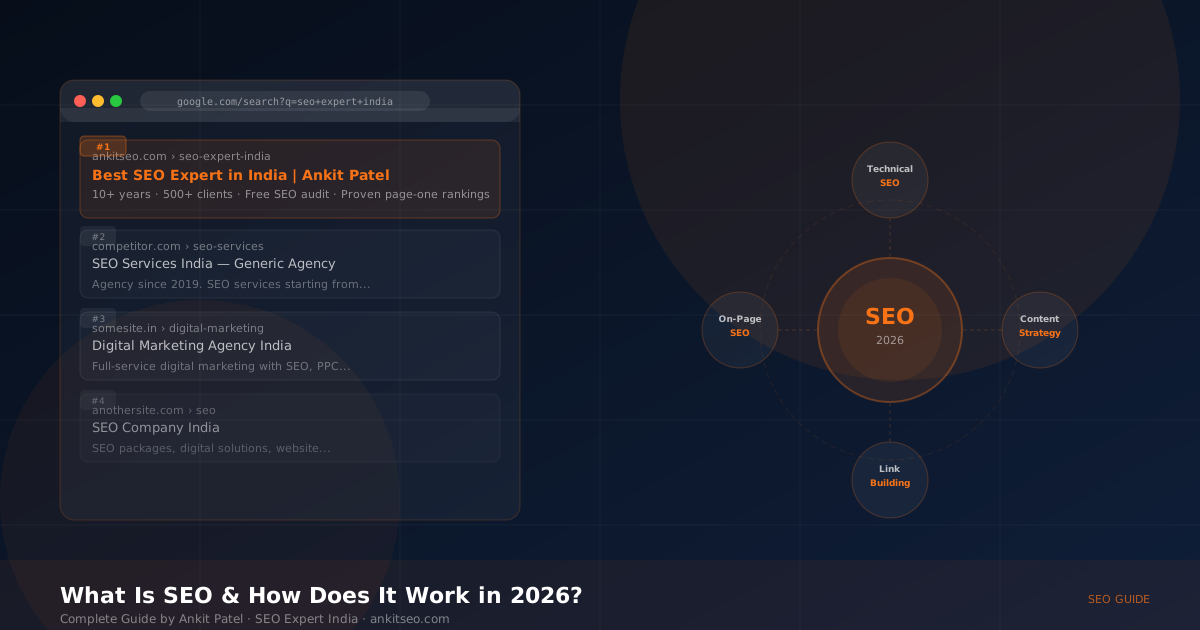
How search engines crawl, index, and rank pages · The core types of SEO and what each covers · Google's most important ranking factors in 2026 · How AI is changing search · 15 common SEO mistakes and how to fix them · A full SEO checklist you can act on today · Realistic timelines for results
What Is SEO?
SEO — Search Engine Optimization — is the practice of improving your website so that search engines like Google rank it higher when people search for what you offer. The goal is simple: appear at the top of the organic (non-paid) search results for keywords your potential customers are actually using.
Let me give you a concrete example. Say you run a dental clinic in Pune. When someone types "best dentist in Pune" into Google, you want your clinic to appear at or near the top of the results. If you're not on page one, you're invisible — 75% of users never scroll past the first page of results.
SEO is the work that gets you there. And unlike paid advertising, which stops delivering the moment you stop paying, SEO builds an asset that grows and compounds over time. A page that ranks well today can continue delivering free, qualified traffic months or years from now without ongoing spend.
SEO vs Paid Ads — The Core Difference
The easiest way to understand SEO is to contrast it with Google Ads. Both get your website in front of searchers, but through completely different mechanisms:
- Google Ads (PPC): You pay every time someone clicks your ad. Stop paying, traffic stops immediately. Results are instant but purely transactional.
- SEO: You invest in improving your site's relevance and authority. It takes months to build, but once you rank, traffic is free. The investment continues delivering value long after the initial work.
Most mature businesses use both — Ads for immediate traffic while SEO is being built, and SEO as the long-term engine that reduces dependence on paid acquisition.
Why Businesses Need SEO
Think about your own search behaviour. When you need to find a plumber, compare accounting software, or research a medical symptom, where do you go? Google. So do your customers. The numbers are staggering:
- Google processes over 8.5 billion searches per day
- Organic search drives 53% of all website traffic — more than any other channel
- The first organic result gets an average 27.6% click-through rate
- Results on page two get fewer than 1% of all clicks
If your business isn't visible in organic search, you are handing those customers to competitors who are. SEO fixes that.
Why SEO Matters More Than Ever in 2026
There's a narrative floating around that AI is killing SEO. ChatGPT, Perplexity, Google's AI Overviews — aren't people just asking AI instead of searching? Here's the reality: Google still processes billions of searches every day. AI assistants are being used alongside search, not instead of it. And crucially, AI-generated search summaries pull their content from websites that rank well — meaning strong SEO is now what gets you cited in AI answers too.
What has genuinely changed is how Google decides what ranks. Let me walk you through the most significant shifts.
AI-Driven Search Understanding
Google's algorithms — particularly MUM (Multitask Unified Model) and Gemini-powered systems — now understand the meaning behind search queries, not just the words. Typing "can dogs eat grapes?" gets a direct health warning, not a list of articles about grapes. This shift means stuffing your page with keywords no longer works. Google understands what your page is actually about.
Search Intent as a Core Signal
In 2026, matching search intent is as important as targeting the right keyword. When someone types "best running shoes," they want to compare options — not read a history of athletic footwear. Google knows this, and it ranks content that satisfies the actual intent of the search. If your page doesn't match what the searcher expected to find, no amount of keyword optimization will keep you ranking.
E-E-A-T: Experience, Expertise, Authoritativeness, Trust
Google's Quality Raters Guidelines emphasize E-E-A-T heavily, especially for health, finance, legal, and high-stakes topics. Who wrote this content? What are their credentials? Is this site a recognised authority in its field? Does it have a reputation for accuracy? These questions now influence rankings. A faceless website with thin, generic content struggles. A site with clear authorship, depth, and a demonstrable track record does well.
Mobile-First Indexing is the Default
Google now indexes and ranks the mobile version of your website first. If your mobile experience is poor — slow loading, hard to navigate, text too small — your rankings suffer, period. With over 60% of searches in India happening on mobile, this isn't a nice-to-have. It's foundational.
Voice and Visual Search
Voice search queries are longer and more conversational ("What's the best SEO agency near me in Ahmedabad?"). Visual search — where users upload images to find similar products or information — is growing rapidly, particularly on Google Lens. Optimizing for these modalities requires different content strategies than traditional text-based SEO.
How Search Engines Work
Before you can optimize for search engines, you need to understand what they actually do. The process has three main stages: crawling, indexing, and ranking.
Stage 1: Crawling
Imagine Google has an army of automated bots — called spiders or crawlers — that constantly travel across the internet following links from page to page. When they land on your website, they read your HTML, follow your internal links, note your images, and record everything they find.
If Google's crawlers can't access your pages — because of technical errors, blocked robots.txt rules, or poor site architecture — those pages won't appear in search results. This is why technical SEO starts with crawlability: making sure Google can find and access every page you want to rank.
Stage 2: Indexing
Once a page is crawled, Google decides whether to add it to its index — the massive database of pages that can appear in search results. Not everything that's crawled gets indexed. Pages with thin content, duplicate content, or that Google deems low-quality may be crawled but not indexed.
You can check whether your pages are indexed by typing site:yourdomain.com into Google, or by reviewing the Coverage report in Google Search Console. If important pages aren't showing up, that's an indexation problem that needs fixing before any other SEO work will have impact.
Stage 3: Ranking
This is where the complexity lives. Once a page is indexed, Google's algorithm evaluates it against hundreds of ranking signals to decide where it should appear for different search queries. It's comparing your page against every other indexed page that's targeting the same terms — and the most relevant, authoritative, and user-friendly result wins.
Google's ranking algorithm considers over 200 factors. The most significant ones in 2026 are covered in detail later in this guide.
How SEO Works Step by Step
SEO isn't a single action — it's a system of interconnected activities that build on each other. Here's how a proper SEO campaign is executed, step by step.
Step 1: Keyword Research
Every SEO campaign starts with understanding what your potential customers are searching for. Keyword research identifies the exact phrases, questions, and terms people type into Google when looking for what you offer — and crucially, which of those searches are valuable enough to target.
Good keyword research looks at three things: search volume (how many people search this each month), keyword difficulty (how competitive it is to rank), and commercial intent (whether the person searching is likely to become a customer). A keyword with 10,000 monthly searches but zero buying intent is less valuable than a 200-search keyword where everyone searching is ready to hire someone.
Step 2: Search Intent Analysis
Once you have your target keywords, you need to understand what searchers expect to find when they use them. This is called search intent. There are four types:
- Informational: "what is technical SEO" — they want to learn
- Navigational: "AnkitSEO contact" — they want to find a specific site
- Commercial: "best SEO agency India" — they're researching before buying
- Transactional: "hire SEO consultant India" — they're ready to act
Your content format, length, and structure should match the intent of the keyword you're targeting. Writing an educational blog post for a transactional keyword — or a sales page for an informational one — will limit your rankings no matter how well-optimized the page is.
Step 3: Content Creation
Once you know what to target and what searchers expect, you create the content. In 2026, great SEO content isn't just keyword-rich — it's genuinely useful, comprehensive, and credible. It answers the question better than the ten pages currently ranking for that term. It demonstrates real knowledge, uses specific examples, and satisfies the reader's full intent rather than giving them a partial answer and hoping they stay on the page.
Step 4: On-Page Optimization
On-page optimization is the process of making sure every technical signal on your page tells Google what it's about and that it's high quality. This includes your title tag, meta description, heading structure, URL, internal links, image alt text, and the strategic placement of your target keywords in natural, readable positions.
Step 5: Technical SEO
Even the best content won't rank if your website has technical problems. Technical SEO ensures your site is fast, mobile-friendly, properly indexed, free of errors, and structured in a way that helps Google understand your content. This is the foundation everything else is built on.
Step 6: Link Building
Off-page authority — primarily measured through backlinks from other websites — remains one of Google's strongest ranking signals. Earning links from reputable, relevant sources tells Google your site can be trusted. This is done through content marketing, digital PR, outreach, and creating resources people want to reference.
Step 7: User Experience Optimization
Google increasingly measures how users actually behave on your site. Do they find what they're looking for? Do they stay and read, or immediately click back to search results? Fast load times, intuitive navigation, clear layouts, and well-structured content keep visitors engaged — and send positive signals to Google.
Step 8: Monitoring, Reporting, and Iteration
SEO is never "done." Rankings change. Competitors adapt. Google updates its algorithm. Monthly tracking of keyword positions, traffic, and conversions tells you what's working, what needs adjustment, and where new opportunities are emerging. The best SEO campaigns are those that adapt continuously rather than setting and forgetting.
Types of SEO
On-Page SEO
On-page SEO covers all optimizations made directly on the pages of your website. These are the signals you have full control over, and getting them right is the foundation of any SEO strategy.
- Title Tags: The clickable headline in search results. Should include your primary keyword, be under 60 characters, and be compelling enough to earn a click. This is one of the most direct ranking signals Google has.
- Meta Descriptions: The short description under the title in search results. Doesn't directly influence rankings, but a well-written meta description dramatically improves click-through rates — which does influence rankings indirectly.
- Heading Hierarchy (H1–H4): Proper heading structure helps Google understand your page's topic structure. Each page should have exactly one H1 (the main topic), followed by H2 subheadings, and H3s for subsections. Don't skip levels or use headings purely for visual styling.
- Content Optimization: Your primary keyword should appear in the first 100 words, in at least one H2, and naturally throughout the body. Semantic keywords — related terms and concepts — should be woven in naturally to build topical completeness.
- Internal Linking: Links between your own pages help Google discover and understand the relationship between your content. They also pass authority from strong pages to newer ones.
- Image SEO: Every image should have a descriptive, keyword-relevant alt text. Compress images to reduce file size without sacrificing quality. Use next-gen formats like WebP.
Technical SEO
If on-page SEO is the message, technical SEO is the delivery system. A technically broken website won't rank, no matter how good the content is.
- Core Web Vitals: Google's page experience metrics — LCP (loading speed), CLS (visual stability), and INP (responsiveness). Failing these benchmarks actively harms rankings.
- Page Speed: Slow pages lose rankings and users. Target under 2.5 seconds for LCP on mobile. Use tools like PageSpeed Insights to identify what's slowing you down.
- Mobile Optimization: Your site must be fully functional and navigable on a 375px-wide screen. Google indexes the mobile version first.
- XML Sitemap: A map of all your important URLs, submitted to Google Search Console so crawlers can find them efficiently.
- Robots.txt: Tells Google which pages to crawl and which to ignore. A misconfigured robots.txt can accidentally block your entire site from indexing.
- Structured Data (Schema Markup): JSON-LD code that tells Google explicitly what type of content is on a page — a product, a FAQ, a recipe, a local business. Enables rich results in search: star ratings, FAQ dropdowns, pricing, and more.
- Canonical Tags: Prevent duplicate content penalties by telling Google which version of a page is the "master" when multiple URLs contain similar content.
- HTTPS: A confirmed (minor) ranking signal. More importantly, users trust secure sites. Any site still running on HTTP in 2026 has a problem.
Off-Page SEO
Off-page SEO builds your website's authority through signals that happen outside your own domain. The most important of these is backlinks — but it's not just about quantity.
- Link Building: Earning links from relevant, authoritative websites through content outreach, guest posts, digital PR, and creating linkable assets (guides, data studies, tools). One link from a high-authority domain is worth more than 100 links from spam sites.
- Digital PR: Getting your business, data, or expert opinions featured in news publications and industry blogs. These earn high-authority links and build brand awareness simultaneously.
- Brand Mentions: Even unlinked mentions of your brand on reputable sites are now believed to contribute to Google's understanding of your authority.
- Social Signals: While not a direct ranking factor, strong social presence increases content distribution, which leads to more backlinks and traffic signals.
Local SEO
For businesses serving customers in a specific geographic area, local SEO is its own discipline with its own ranking factors — separate from traditional web search rankings.
- Google Business Profile (GBP): Your GBP listing is what appears in Google Maps and the local 3-pack. Fully optimize it with accurate NAP (Name, Address, Phone), business categories, photos, and regular posts.
- Local Citations: Consistent mentions of your business name, address, and phone number across directories like JustDial, Sulekha, IndiaMart, and Yelp build local authority.
- Reviews: The quantity, rating, recency, and content of your Google reviews directly influence Maps rankings. A strategy for generating authentic reviews is essential.
- Locally Relevant Content: Pages and blog posts targeting city-specific keywords ("SEO services in Ahmedabad") help Google understand where you serve.
E-Commerce SEO
Online stores face unique SEO challenges that require specialized approaches. Learn more in our dedicated e-commerce SEO service.
- Product Pages: Each product needs a unique, keyword-optimized title, description, and meta tags. Avoid thin descriptions copied from manufacturers.
- Category Pages: Often the highest-traffic pages on a store — they should be optimized for broad category keywords and link clearly to relevant products.
- Product Schema: Structured data that enables price, availability, and review star ratings to show in search results — dramatically improving click-through rates.
- Faceted Navigation: Filter pages (colour: red, size: XL) create thousands of duplicate or thin URLs. Handling these correctly with canonical tags and robots.txt is critical for large stores.
Top Google Ranking Factors in 2026
Google's algorithm uses over 200 signals. These are the ones that matter most in 2026:
- Content Quality and Depth: Does your content genuinely answer the search query better than competing pages? Thin, shallow content doesn't rank. Comprehensive, accurate, well-structured content does.
- Search Intent Match: Does your page format match what searchers expect? A blog post for an informational query, a product page for a transactional one, a comparison guide for a commercial investigation query.
- Topical Authority: Does your site have a cluster of deeply interlinked, comprehensive content on a topic? Sites that cover a subject thoroughly across multiple pages tend to outrank those with isolated articles.
- Page Speed and Core Web Vitals: LCP under 2.5s, CLS under 0.1, INP under 200ms. Google measures actual user experience, not just lab scores.
- Mobile Usability: Since Google indexes mobile-first, any mobile usability issues directly impact all rankings.
- Backlink Quality and Relevance: Links from authoritative, topically relevant sites carry significant weight. Spam links can actively harm rankings.
- E-E-A-T Signals: Clear authorship, author credentials, about pages, citations from other authoritative sources, and a history of accurate information build the trust signals Google values.
- User Engagement: How long do users stay on your page? Do they click back to Google immediately (a bad sign) or explore your site further? Google's systems observe these patterns.
- Structured Data: Schema markup helps Google understand your content precisely and can unlock enhanced rich results that improve click-through rates.
- Helpful Content: Google's Helpful Content system demotes content that exists primarily to rank rather than to genuinely help users. Every piece of content should have a clear reason to exist for the reader's benefit.
The Role of AI in SEO in 2026
AI has become impossible to ignore in SEO conversations. Let me separate the genuine changes from the noise.
Google AI Overviews
Google's AI Overviews appear at the top of search results for many queries — a synthesized answer pulled from multiple sources, with citations. Here's the critical insight: those citations come from pages that already rank well. Getting featured in AI Overviews isn't a separate optimization task — it's the result of doing traditional SEO well and writing content that directly, clearly answers questions.
AI-Assisted SEO Work
AI tools like Claude, ChatGPT, and Gemini are now part of the SEO toolkit for research, content outlining, and first-draft generation. Used well, they accelerate the workflow. Used poorly — publishing raw AI output without expert review and fact-checking — they produce the kind of generic, mediocre content Google's Helpful Content system is specifically designed to demote.
AI-generated content that is published without expert review, original insight, or genuine value-add is one of the fastest ways to damage your SEO in 2026. Google can identify patterns of AI content at scale, and sites that rely on mass AI publishing without quality control face ranking penalties.
AI Search Engines (Perplexity, ChatGPT Search)
Alternative AI search platforms are growing rapidly. While Google still dominates with over 90% market share, optimizing for being cited in AI answers requires the same fundamentals: authoritative content, clear factual statements, structured information that AI systems can parse and cite accurately.
How to Adapt Your SEO for AI Search
- Write content with clear, direct answers to questions — especially in the first paragraph
- Use structured formats (lists, tables, definitions) that AI systems can extract cleanly
- Build genuine topical authority rather than chasing individual keywords
- Focus on original data, insights, and perspectives that AI can't generate itself
- Maintain strong E-E-A-T signals — author credentials, accurate citations, up-to-date information
15 Common SEO Mistakes to Avoid
1. Keyword Stuffing
2. Thin Content
3. Duplicate Content
4. Ignoring Technical SEO
5. Slow Page Speed
6. Missing or Weak Title Tags
7. Poor Internal Linking
8. Buying Spam Backlinks
9. Ignoring Mobile
10. No Schema Markup
11. Targeting Wrong Keywords
12. Ignoring Google Search Console
13. Mass AI Content Without Review
14. Neglecting Local SEO
15. Expecting Overnight Results
SEO Results Timeline: What to Expect
One of the most common questions I get is "how long will this take?" Here's an honest, realistic breakdown based on hundreds of campaigns:
Foundation
- Technical audit complete
- Critical errors fixed
- Google Search Console configured
- Keyword strategy mapped
- Google starts re-crawling
Early Signals
- Rankings begin moving
- On-page optimizations indexed
- Long-tail keywords gaining traction
- Impressions increasing in GSC
- Initial content ranking
Meaningful Growth
- Consistent traffic increases
- Page-one rankings appearing
- Link building gaining authority
- Organic leads visible
- Competitor gap closing
Strong ROI
- Multiple competitive page-one rankings
- Significant organic revenue
- Brand authority established
- Compounding traffic growth
- Reduced paid ad dependence
The timeline varies significantly by industry competitiveness, current site health, and how aggressively the campaign is executed. A brand-new domain in a competitive niche will take longer than an established site with existing authority making targeted optimizations.
SEO vs Google Ads: When to Use Each
| Factor | SEO | Google Ads (PPC) |
|---|---|---|
| Speed to Results | 3–12 months | Immediate (same day) |
| Cost Structure | Investment; no per-click cost | Pay per click — ongoing cost |
| Traffic Sustainability | Continues after investment stops | Stops immediately when budget stops |
| Long-Term ROI | High — compounds over time | Medium — consistent but cost-dependent |
| Click-Through Rate | Higher trust (organic results) | Lower (users know it's an ad) |
| Scalability | Scales without proportional cost increase | Scales linearly with budget |
| Brand Building | Strong — consistent visibility builds recall | Limited to active campaign periods |
| Best For | Long-term growth, brand authority, reducing CAC | Product launches, promotions, filling pipeline while SEO builds |
The smart answer is both. Use Google Ads for immediate traffic and testing while SEO builds your organic foundation. As SEO matures, you can reduce ad spend proportionally — or reinvest it in competitive keywords where organic rankings are harder to achieve.
SEO Checklist for 2026
Technical SEO
- Run a full technical audit (Screaming Frog or Ahrefs) — fix all crawl errors
- Submit XML sitemap to Google Search Console
- Verify robots.txt isn't blocking important pages
- Achieve LCP under 2.5s on mobile (PageSpeed Insights)
- Fix CLS issues — ensure no layout shifts above 0.1
- Ensure all pages are HTTPS — fix any mixed content warnings
- Set up and verify canonical tags on all pages
- Implement structured data (Schema) for your page types
- Check mobile usability report in Google Search Console — zero errors
- Verify all important pages are indexed — use site: search or GSC Coverage report
On-Page SEO
- Each page targets one primary keyword — no cannibalisation between pages
- Title tag includes primary keyword, is under 60 characters, and is click-worthy
- Meta description is under 155 characters with a clear value proposition
- Each page has exactly one H1 — with the primary keyword
- H2 and H3 headings are used in logical hierarchy with secondary keywords
- Primary keyword appears in the first 100 words of the body
- All images have descriptive alt text — compressed to WebP format
- URL slugs are short, lowercase, and keyword-descriptive (e.g. /seo-services-india)
- Internal links connect related pages with descriptive anchor text
- No broken internal links — run a crawl and fix all 404s
Content SEO
- Content fully satisfies the search intent of the target keyword
- Minimum 800 words for competitive terms — depth beats length though
- Author name, credentials, and date visible on all blog posts
- Content includes original insights, data, or examples — not just restated facts
- Semantic keywords and related entities naturally woven into content
- FAQ section on relevant pages — formatted for featured snippets
- Content is updated when information becomes outdated
Off-Page SEO
- Audit existing backlink profile — disavow toxic links if present
- Identify top competitor backlinks — target similar sources
- Create at least one linkable asset per quarter (guide, data study, tool)
- Set up Google Alerts for brand mentions — convert unlinked mentions to links
- Guest post on relevant industry publications — one or two per month
Local SEO
- Google Business Profile fully completed — all categories, photos, hours, services
- NAP (Name, Address, Phone) consistent across all directories
- Listed on major Indian directories: JustDial, Sulekha, IndiaMart, Yellow Pages
- Active review generation strategy — respond to all reviews within 24 hours
- Location pages created for each city or region you serve
- LocalBusiness schema implemented on contact and location pages
Why Businesses Choose AnkitSEO
I want to be straightforward here: there are thousands of SEO consultants and agencies in India. So why do 500+ businesses — from local shops to national e-commerce brands — choose AnkitSEO, and why do 98% of them stay?
It comes down to a few things that I've found matter most to business owners who've been burned by promises before.
Real experience, not theory. I've been doing this for over 10 years across 30+ industries. The patterns you only learn from running hundreds of actual campaigns — what works in competitive niches, how to recover from algorithm penalties, what Indian consumers search differently than global audiences — that knowledge isn't available in any course or certification.
Strategies built for your business, not templates. I don't have packages with preset deliverables. Every campaign starts with understanding your specific business, your customers, your competitors, and your goals — and building a strategy around that. A local clinic in Surat needs a completely different approach than a national SaaS company.
Technical expertise that runs deep. SEO in 2026 is deeply technical. Core Web Vitals, JavaScript rendering, crawl budget optimization, log file analysis, schema implementation — these are skills that separate effective SEO from surface-level keyword work. We operate at the technical depth your rankings actually require.
Full transparency, always. You get access to real-time dashboards, monthly performance reports, and direct communication. You'll never wonder what we're doing or why your rankings moved. If something isn't working, we tell you before you ask — and we fix it.
If you're ready to see what professional SEO services can do for your business, or if you want to understand what's holding your current rankings back, the best starting point is a free SEO audit.
Frequently Asked Questions About SEO
Conclusion: SEO in 2026 Is an Opportunity, Not a Mystery
We've covered a lot of ground in this guide. Let me bring it back to the essentials.
What is SEO? It's the practice of making your website the most relevant, trustworthy, and technically sound answer to the questions your customers are searching for. When done right, it's the most cost-effective marketing channel available — delivering compounding returns that continue growing long after the initial investment.
In 2026, SEO has gotten more sophisticated but not more mysterious. The fundamentals haven't changed: create genuinely useful content, make sure your site is technically sound, earn authority through quality backlinks, and match what you publish to what searchers actually want to find. What's changed is the depth required to do each of those things well.
Google's AI systems are better at identifying quality than ever before. That means shortcuts that worked in 2019 are now liabilities. But it also means that businesses willing to invest in real, substantive SEO — the kind that serves their customers rather than gaming an algorithm — are rewarded more durably than at any point in the past.
The 96% of websites getting zero organic traffic aren't invisible because SEO is hard. They're invisible because they haven't done it. That gap is your opportunity.
If this guide has given you a clearer picture of what SEO involves and what it takes to rank in 2026, the logical next step is understanding exactly where your website stands right now. We offer a free SEO audit — a detailed review of your site's technical health, current rankings, and the biggest opportunities for growth. No obligation, no sales pressure. Just clarity on what's holding you back and a roadmap to fix it.
Ankit Patel
Ankit Patel is an SEO Expert and SEO Consultant helping businesses improve their Google rankings, organic traffic, lead generation, and online visibility. With expertise in Technical SEO, On-Page SEO, Local SEO, Ecommerce SEO, Shopify SEO, and WordPress SEO, he provides data-driven SEO strategies designed for sustainable long-term growth.